The Children’s House Community is a carefully-prepared, child-sized classroom in which your young child can direct her own activity, building confidence and social skills.
The Children’s House includes five different classroom areas, each one with enticing and sequenced materials that your child will be introduced to over a three-year period, in response to her individual developmental timeline.
The oldest children in the Children’s House are role models and helpers for the Younger children, and the younger children love to look up to and learn from their older peers.
Children’s house community3 to 6 years old
Developing independence through practical life
When your child joins his Children’s House Community, his first experiences will be with the practical life activities.
These lessons engage your child with real-world, purposeful tasks and tools, helping him see himself as capable and competent.
The practical life activities may appear to be unrelated to “academic learning”, but Nothing could be further from the truth.
These activities are complex, with many steps that must be performed sequentially in order to achieve the result.
They give your child the opportunity to develop concentration and prepare your child for writing, by strengthening his hand and introducing activities that flow from left to right.
Most importantly, they allow your child to absorb the basic, methodical problem solving approach that is the foundation for all thought or creative expression, including such diverse areas as math, science, engineering, programming, writing, artistic expression, entrepreneurism or even mastery of a sport.
The essential skills developed through the practical life activities will form the basis for all further learning as your child grows.
Writing and reading joyfully
The Montessori approach to language study makes Learning appear effortless, because it recognizes the individuality of each child.
Maria Montessori noticed that in each child’s development there is a window of time, occurring at a slightly different time for everyone, when the child suddenly becomes interested in written language.
When this moment comes, if the tools are available to feed her interest, she will joyfully “explode into” writing, then reading.
Your child’s guide watches closely for this moment, while patiently building the foundation that will allow her to tackle writing and reading with confidence and joy!
Developing the scientific mind through the sensorial material
Children this age use their senses to explore the world.
Theyenjoy the beautiful sensorial material and learn to compare and contrast, to discern slight differences, to place things in order, and so on.
From scientists to artists, adults benefit from the ability to really look at what is in front of them: to notice small details about the world that have significance for their work.
The sensorial material also highlight mathematical relationships that exist in the real world, providing the foundation for understanding arithmetic, geometry and algebra.
These materials allow a child to develop mastery over his observational powers: the sensorial mastery of the scientist, the artist, the mathematician.
The foundations of history and science
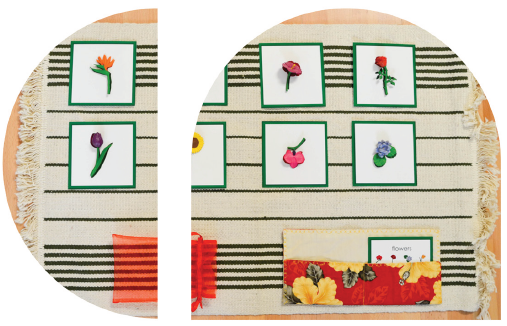
Geography and culture lessons in the Montessori classroom offer the inspiration for your child’s future study of history and science (starting with geology,botany and biology).
Your child’s early experimentation with physical properties, land and water forms, natural objects, gardening, sorting, parts of animals, and parts of plants inspires her to fall in love with the scientific world.
Her work with puzzle maps, flags, cultural items, and beautiful cultural photographs to compare and categorize introduces her to varied geographies and cultures, and represents the first steps on a path that will later lead to the study of history.
Mathematical fluency
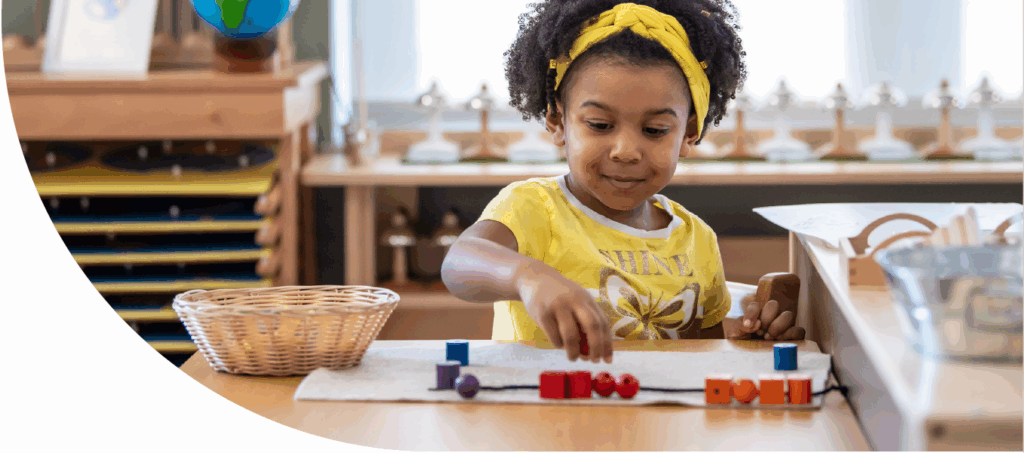
Your child will experience the wonder of math through engaging materials that inspire concrete understanding and joyful problem-solving, paving the way for a smooth transition to abstraction.
Our rich and varied mathematical materials build skills gradually.
Children work with the decimal system into the thousands, are exposed to addition, subtraction, multiplication, and division, and develop a keen number sense, the foundation for a lifetime of mathematical fluency.

Socializing with “grace and courtesy”
Because children in the Children’s House move freely,choosing their own work and places to sit, or when to take a break and have a snack with a friend, your child will have plenty of opportunities to practice social interaction!
The Montessori guide will share lessons that your child can practice in various social circumstances.
These simple, clear lessons in everything from asking to sit with someone to blowing one’s own nose or saying “excuse me” give your child the tools he needs to interact successfully in his world.
Children are ready for the Children’s House once they can reliably use the toilet independently, and are showing signs of increasing attention span.