Your elementary child gains a whole new perspective, seeing the world through a newly expanded imagination and with an increasing ability to think abstractly.
Your child’s classroom offers inspiring daily opportunities to explore the world from this new point of view.
Elementary Program6 to 11 years old

Providing a Framework for Discovery
At the beginning of each school year, your child’s teacher shares Montessori’s “Great Lessons,” designed to ignite the imagination and encourage curiosity.
The Great Lessons appeal directly to the new imaginative and abstract capacities of the elementary child’s mind, which allows them to journey through history and envision faraway places, to consider the smallest building blocks of matter, and to contemplate the enormity of the universe.
These captivating story-lessons are told with a sense of wonder and awe, and concepts are shared through exciting experiments, colorful timelines, and impactful charts.
These five stories have enticing names, such as The Coming of Life and Communication in Signs (the story of language).
They provide an overarching knowledge framework for further study of science and history, and they fascinate the elementary child and inspire ongoing interest.
Subsequent lessons share details and connections that fit into the broad structure provided by the five Great Lessons.
The Fundamentals of Inspiration
The five Great Lessons are told yearly at the beginning of each school year, but this type of highly motivating storylesson is fundamental throughout the Montessori Elementary program.
Intriguing lessons share specific key information in diverse areas and awaken your child’s mind to the power of language, math, human discovery, and human ingenuity.
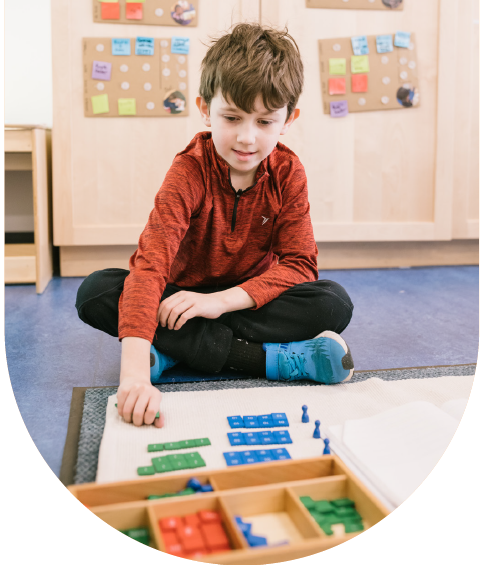
Across our whole curriculum, knowledge is presented in a highly motivated, integrated, clear framework with engaging hands-on materials.
In addition to this common knowledge framework, extended work periods give time and freedom for intense repeated practice or deep student-led research.

Motivated Skill-Building
The Montessori guide’s goal is to uncover and build on your child’s motivation, then support focused exploration by scaffolding the development of specific skills.
Whether your child is working on discovering patterns in math, or diving into a research project, your child will practice and solidify concrete skills while making and sharing his discoveries.
Your child’s teacher observes each student closely, giving lessons to small groups, based on interest and ability, and presenting new challenges just when a child is ready.
Education that meets the standards of the French National Education system.
Our Montessori educators have an in-depth mastery of the common foundation of knowledge, skills, and culture as defined by the French Ministry of Education.
By carefully presenting the activities and learning experiences within our educational program, children develop strong and well-rounded competencies.
Thanks to our attentive and individualized teaching approach, students are not only thoroughly prepared for the transition to middle school (6ème), but they also often enter with a level of understanding and skills that places them ahead of what is expected at the beginning of middle school.
This ensures a smooth and harmonious educational progression, fostering self-confidence and academic success.
Downtime Matters!
Downtime is vitally important to mental health and to learning. During downtime, the brain absorbs and integrates new concepts, inspiring innovation and creativity.
A child develops empathy and a sense of belonging through unstructured play with friends, practices innovating while solving the problems of daily life, and connects with family through unhurried family activities or games.
For maximum learning, under-schedule, don’t overschedule, during the elementary years.
Supporting Your Child’s Learning at Home
We know that downtime, independent exploration, and unstructured play are vitally important for the child of this age, so we have a low-to-no-Homework approach during the elementary years.
The elementary child works intensively at school each day, and we encourage you to support your child’s learning at home in a variety of ways.
Share your own passions with your child, using a storytelling approach.
Remember that your child will be more likely to engage if you check in first, like this: “I thought of something I remember from travelling in France—can I share a story?”
Find an intriguing way to invite your child’s participation, add in the “wow factor”, keep your story short to inspire questions, and bring it up again later if your child isn’t interested the first time you offer.
Once your child’s imagination is engaged, they’ll be eager to master associated skills and learn detailed information.
Encourage your child to follow their interests at home just like they do at school.
If your child is excited about insects, go to the local river park to collect and study bugs together.
If your child can’t stop talking about rocks, work with him to research and plan a geology-focused family camping trip.
Fill your home with the joy of shared adventure and protect your child’s downtime to allow for plenty of time to create and explore.